
The Paradox of Free Will in Therapy
A reflection on the tension between choice, limitation, and the lived experience of free will as it appears both within therapy and in everyday life.
The Audio Reflection
Listen on: Apple Podcasts | Spotify | YouTube | RSS
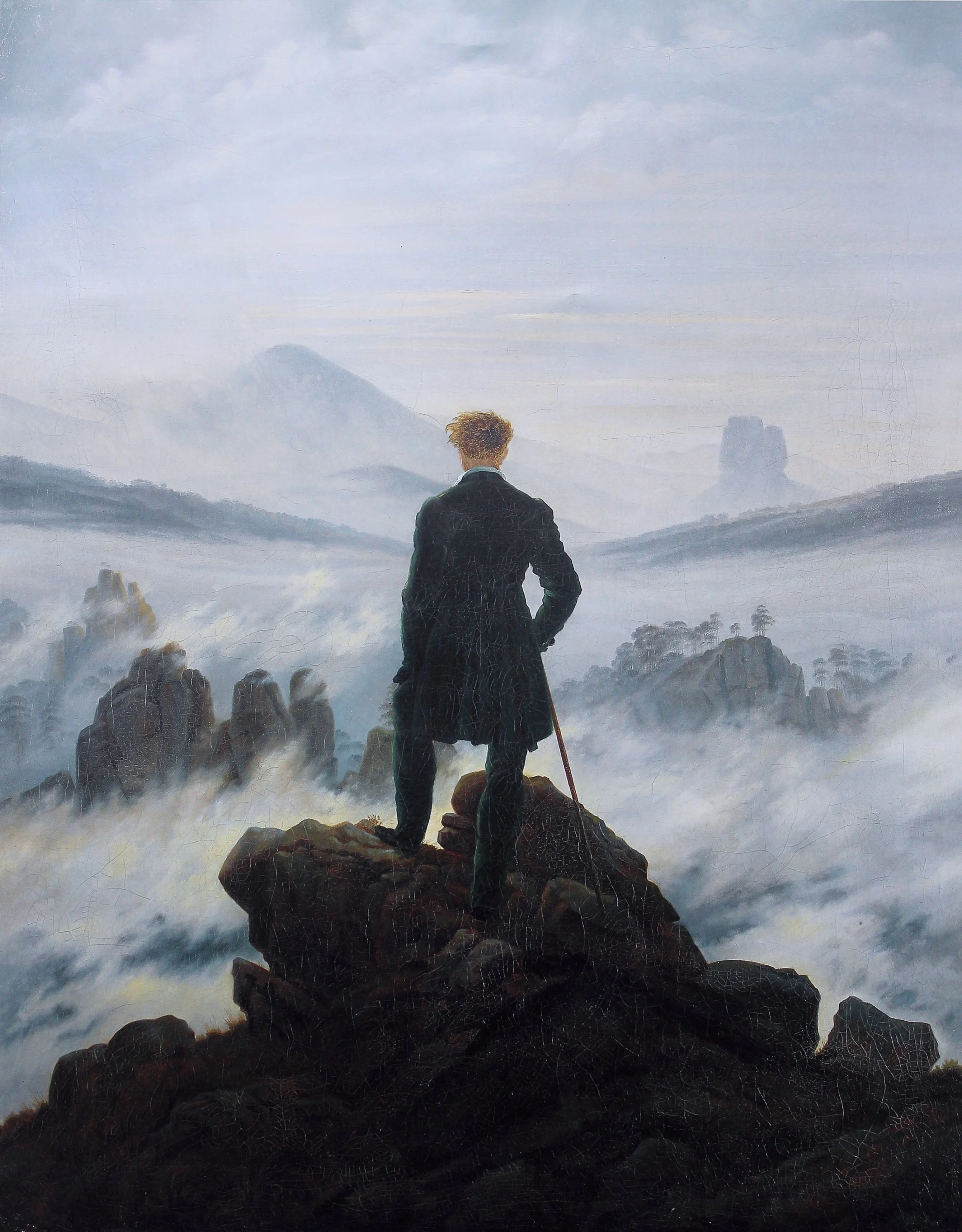
Wanderer above the Sea of Fog, 1818
Caspar David Friedrich
On the Nature of Free Will
There is a problem hiding in plain sight across the entire field of psychotherapy—a blind spot that shows up just as readily in couples therapy as it does in existentially focused work. It is the question of our freedom, or more specifically, the nature of free will.
Existentialism rests on the basic assumption that human beings possess some degree of agency over the choices we make. Without the belief that we can respond to our circumstances in meaningful ways, therapy of any kind would lose its footing. If we had no capacity to choose differently, what would be the purpose of psychotherapy at all?
Yet this assumption is becoming increasingly complicated by the cultural moment we live in.
Many people describe feeling less in control of their lives than previous generations. Rapid technological change, widening inequality, and increasingly complex social systems have left many with a sense of being acted upon rather than being active participants in their own lives. Whether or not this perception captures the full truth of our situation, what matters clinically is that the felt sense of diminished agency has become a genuine feature of modern life.
Some thinkers, such as Yanis Varoufakis in Technofeudalism, describe this cultural mood as a kind of digital serfdom—not as a strict political claim, but as a reflection of how powerless many people feel in the face of contemporary systems.
This cultural backdrop makes the idea of individual choice—and the responsibility that flows from it—deeply complex for many. And when we consider these questions alongside structural disadvantage, multicultural realities, and what existentialists call thrownness (the conditions we are born into without choosing), the topic becomes even more charged.
Yet despite these complexities, I believe the staunch determinist position—argued most famously by Sam Harris—is incomplete. The claim that free will is purely an illusion is, at best, a partial truth and, at worst, a misunderstanding of lived experience.
Below are three dimensions that, for me, help understand the paradox of free will in therapy.
1. Constrained Freedom Is Still Freedom
I’ve come to believe that free will does not exist as a simple yes/no proposition. Rather, it exists along a gradient.
On one end are situations where individuals have almost no meaningful ability to choose (a person imprisoned in a jail cell, for example). On the other end is a billionaire deciding where to fly for dinner. These extremes appear to demonstrate vastly different degrees of freedom.
But Viktor Frankl’s Man’s Search for Meaning complicates this picture. Frankl shows that even under the worst possible conditions, there remains an inner freedom: the ability to choose one’s stance toward one’s suffering. So the gradient might itself be, in part, an illusion created by external observers.
From the inside—within one’s consciousness—there is always a fragment of choice, however small. And this fragment profoundly matters.
This points toward a truth: our freedom of choice is constrained by context but not totally determined by it. Consider:
You cannot fly, but you can choose where to walk.
You cannot erase your past, but you can choose your stance toward it.
You cannot choose your genetics, but you can choose your habits.
Freedom from this perspective is not an absolute, It’s always situated, always contextual, and often ambiguous.
Agency exists within this field of constraints—not outside it.
This is where Harris’s argument collapses: he assumes that unless freedom is infinite, it is nonexistent. But constrained freedom is still freedom, in the same way constrained movement is still movement.
2. Consciousness Is Active, Not Passive
Consciousness exists in a kind of hallucinatory space, an interpretive layer added to reality. In that sense, describing aspects of consciousness as “illusory” isn’t entirely wrong. Our experience of self, time, and narrative is constructed. And yet it also exists, and we do in fact experience something we call consciousness.
If you believe that consciousness exists at all, then you have to admit that it plays some role within the causes and conditions of our existence. It is an active part of the causal chain, and because of this, it must have some impact on how reality unfolds for us, even if that impact is small or heavily constrained by context.
The hard-line claim that our sensation of choice is only an illusion is fundamentally incompatible with the lived truth that consciousness is active, not passive. In therapeutic terms, this is obvious: awareness changes behavior, said another way anxiety is something real we can understand and change.
People do not just have experiences—they interpret them, remember them, reframe them, and respond to them differently over time. This is consciousness at work. And once you acknowledge that consciousness participates in shaping our responses, determinism can no longer be absolute.
3. Human Change Contradicts Pure Determinism
If determinism were total, we would not see ourselves change—especially when the context of our lives has profoundly influenced our existence.
Yet I’ve seen firsthand how people can:
recover from substance use or compulsive behaviors
Charge ones relationship to anxiety, depression or overthinking
have massive breakthroughs in therapy
shift how they relate to themselves and others
discover meaning where previously there was only despair
Through this expanded capacity to understand existence, lives can radically change.
These things happen in and outside of therapy every day, not because people somehow escape their context or eliminate the limits in their lives, but because they expand their capacity within those limits. As a result, they begin to make choices that are better aligned with the reality they wish to live within.
Effectively, therapy as individuals or couples does not manufacture new choices. What it does is expand inner space, our awareness, tolerance, insight, self-compassion—that expansion is what allows new choices to occur.
This is a missing piece in many free-will debates:
The difference between choice and capacity.
Choice is the moment of action.
Capacity is the inner space that makes that action possible.
Most clients do not lack options in any literal sense. What they lack the capacity to choose—because of trauma, shame, overwhelm, internalized beliefs etc. Therapy widens the possibility space. And once that space widens, new choices naturally follow.
The Paradox
I believe free will is foundational to our sense of self and being, but it exists within a container—a set of causes and conditions that shape, limit, and sometimes expand our agency.
In some moments—like writing these words, or placing a brush on a canvas—our freedom feels expansive. In other areas—what careers are available to us, who we can afford to be, the bodies we inhabit—our choices are much more tightly constrained by context.
This is the existential paradox:
We are at once shaped by deterministic forces and yet capable of moments of profound freedom.
Frankl’s lessons from the camps feel more urgent now than ever. We must resist the cultural drift toward all-or-nothing narratives—that we are either entirely free or entirely trapped. In almost every moment of life, both are true to varying degrees.
Our task, both philosophically and therapeutically, is to learn how to discern the difference:
